A Quiet Reading Routine for a Story That Keeps Changing
A quiet reading routine for a developing story helps you compare dated versions, spot meaningful edits and keep an unresolved difference clear.
You open a local story on the bus and notice that a sentence about a council decision has changed since breakfast. A quiet reading routine for a developing story lets you record the versions you actually read, then compare their wording without guessing why it changed.
Keep the task small: note when you read the page, preserve the relevant wording, and identify the difference. This is a record of what appeared to you, not a reconstruction of what happened inside the newsroom.
What should a version note contain?
Record the article title, link, date and time you read it, plus any publication or update label on the page. Copy the relevant sentence into a note, or summarise it closely if copying is inconvenient. A bookmark alone may lead to a page that has since changed.
Separate three things in your note: what the article says, what it attributes to a named source, and what you infer. For instance, “the article says the meeting was postponed” is an observation; “the council clerk is the source” records attribution; “the change was made to avoid criticism” is an inference unless the article establishes it.
Think of dated notes as labels on folders: they help you find each version, but they do not decide what the contents mean.
Which way of recording changes suits you?
When is a dated note enough?
Use a dated note if you want to remember the broad development of a story. Add the new detail and the exact wording of any sentence that matters to your question. If you later need to identify every altered passage, move to a version comparison.
When should you save two versions?
Keep copies of the relevant text if you need to compare specific wording. A plain-text document or notes app is enough; label each copy with its reading time and the source link. Compare the sentences around an edit too, because context can change its meaning.
What does a change log add?
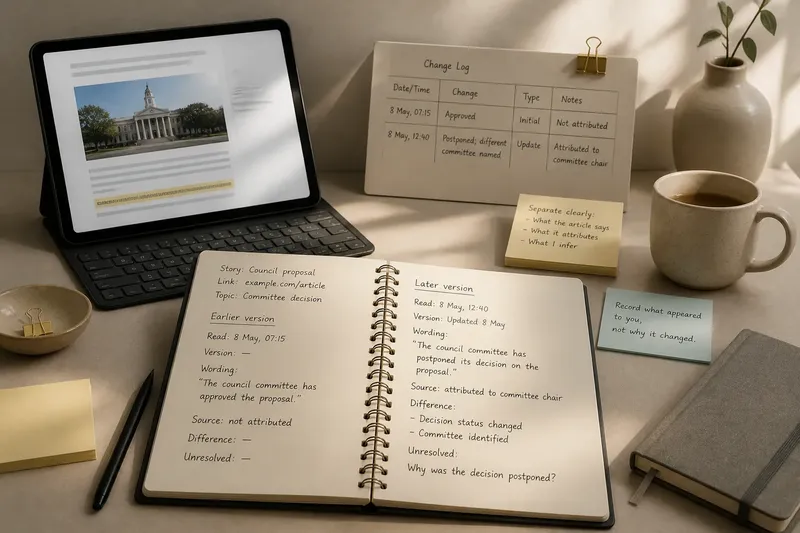
A change log gives you a running record without storing every full page. Add a dated entry for each visit, noting what was added, removed, clarified or explicitly corrected. It suits repeated readings; if the story barely changes, a single dated note is simpler.
How should you decide what a change means?
Compare the same claim across versions. Check whether it refers to the same people, event and time, then note what changed in the wording or attribution. A new detail, a narrower claim and an acknowledged correction are different editorial actions, even if each alters the page.
- New detail: If the later version adds information, record what it adds; if it does not affect your question, keep the note brief rather than saving the whole page.
- Narrower wording: If a broad statement becomes limited to a particular group or place, note the limit; if the scope remains unclear, preserve the wording and mark the scope as unresolved.
- Attribution added or changed: If the article names who supplied a claim, record that source; if no source is identified, write “not attributed in this version” rather than supplying one.
- Correction stated: If the page acknowledges an error, note both the correction language and the revised detail; if it changes the fact without explaining why, record that no explanation is given.
- Two incompatible statements: If both versions make different claims about the same event and circumstances, mark the difference as unresolved; if they concern different times or conditions, record those distinctions instead of calling them contradictory.
- Only wording or structure changes: If the facts and attribution remain the same, describe the edit as a wording or placement change; if you cannot tell whether its meaning shifted, save the relevant passages for closer comparison.
Look for an update line or editor’s note, but do not treat its presence or absence as evidence of motive. If a change matters to a public claim or a decision you need to make, seek an explanation from the publisher or consult reliable reporting on that point.
What questions help when comparing versions?
What did the earlier version actually say?
Use the dated copy or note, not your memory of the headline. Keep the relevant sentence and its date together so you can see what information was present when you read it.
Who is the article relying on?
Check whether a claim is attributed to an official, document, witness or another source. If the source changes between versions, record that change separately from any change to the claim itself.
Does the page explain the edit?
Read any correction, update line or editor’s note alongside the revised passage. If no reason appears, record that absence plainly and leave the reason open.
Is another visit likely to answer a question?
Return if you have a specific unresolved point or the article identifies a relevant new document or announcement. If the latest version adds nothing relevant to your notes, stop rather than revisiting the page without a purpose.
How can you make the record useful without making it a chore?
Choose one method before you begin: a dated note for a broad record, saved passages for a wording comparison, or a change log for several visits. Use a simple format for each entry:
- Read: date, time and link.
- Version: the page’s update label, if shown.
- Wording: the relevant sentence or a close summary.
- Source: who the article attributes the claim to, if anyone.
- Difference: what was added, removed or clarified.
- Unresolved: the question you cannot answer from the page.
Say you read a report before work that says a council committee has approved a proposal. In this invented situation, your starting inputs are that sentence, the page link and your reading time; you enter them in a dated note. Later, the page says the committee postponed its decision and identifies a different committee. You save the revised wording, compare the two passages and record that both the decision status and committee changed. Because the two versions describe different outcomes for what appears to be the same proposal, your result is “unresolved difference”; you do not infer why the edit happened, and you keep both passages if the reason matters to you.
When should you stop keeping notes?
Stop when another visit is unlikely to clarify a question you have. If you may need the record later, keep the dated notes and close the page; a story can continue to develop without requiring you to monitor every edit.
A quiet reading routine for a developing story works best when each entry distinguishes the page’s wording, its sources and your own interpretation. That separation leaves you with a useful record—and makes it easier to say precisely what remains unknown.