Why Editors Put the Newest Detail Near the Top
Why editors put the newest detail near the top: see how an inverted-pyramid edit gives readers the essential update before background and context.
At 8.12 on a wet Tuesday morning, a council notice lands in the inbox of a local newsroom: the footbridge over Mill Lane is closed after an inspection, and the diversion starts now. An editor has a few paragraphs from a reporter, including the closure, the inspection and the bridge’s long history. The first decision is what a reader needs before anything else. That is why editors put the newest detail near the top.
This arrangement is known as the inverted pyramid: the report opens with its most immediately useful information, then adds supporting detail and background in descending order of urgency. It is not a rule that every story must follow. It is a way to make a report understandable even if someone reads only the opening, or an editor needs to shorten it from the bottom.
What goes into the opening?
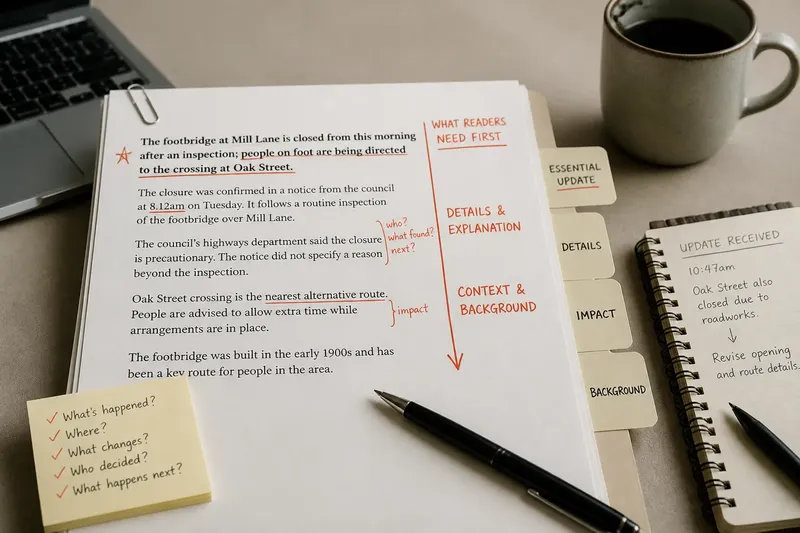
For the Mill Lane report, the opening should tell readers that the footbridge is closed, where it is, and what changes for people crossing the lane. “The footbridge at Mill Lane is closed from this morning after an inspection; people on foot are being directed to the crossing at Oak Street” gives a reader a usable update. The notice’s administrative wording can wait.
The first sentence does not have to contain every answer. It should establish the event and its consequence without making readers infer the point from a quotation or a long preamble. If the diversion route is not confirmed, the editor should not suggest that it is. A clear limit on what is known is more helpful than a smooth but unsupported detail.
Editors often ask whether a fact changes what a reader can do, understand or reasonably expect. In this case, the closure and diversion matter straight away; the age of the bridge does not. That distinction helps set the order without pretending that background is unimportant.
How does the report descend from news to context?
After the opening, the report can explain who made the decision, what the inspection found and what officials say happens next. The next paragraph might name the council department responsible and state whether the closure is precautionary or follows a specific concern. If the notice gives no reason beyond “inspection”, the report should preserve that limit rather than supply a guess.
Then comes information that helps readers interpret the update: the usual route, the nearest alternative, and the practical effect on people who use the bridge. These details belong above a paragraph about when the bridge was built or how it fits into the area’s history, unless that history explains the current closure.
Think of the structure as a stack of labelled folders. The top folder holds what someone needs to act on; the lower ones hold evidence and context that make the top folder clearer. A reader who continues gets depth, while a reader who stops early still receives the core update.
Why did the inverted pyramid become common?
The inverted pyramid became a familiar form in news writing partly because it suited the practical conditions of reporting and publication. Newsrooms needed ways to send accounts quickly and make them usable when space or transmission time was constrained. Putting the central information first meant a report could still communicate its main point if later material had to be cut.
That history explains the form’s usefulness, not a requirement to make every story sound alike. A developing report, a profile or an investigation may need a different opening to establish a person, a question or a chain of evidence. Even then, editors can borrow the core discipline: know what the reader most needs to understand, and do not bury it beneath material that can wait.
How should an editor handle a changing detail?
Imagine the council confirms later that the diversion at Oak Street is also closed because of roadworks. The editor should revise the opening if that change alters the route readers can use, then update the relevant paragraph below it. Leaving the old diversion in the first sentence while correcting it lower down would make the report internally confusing.
The update also needs a clear account of what changed and when the newsroom learned it. Keep the earlier information only if it helps explain the sequence, and mark it as superseded rather than letting it look current. The point of placing the newest relevant detail high is not simply to chase recency; it is to keep the report’s most useful account aligned with what is known now.
What questions help decide the order?
Does the newest fact always belong first?
No. A fresh detail belongs near the top when it changes the story’s meaning or immediate relevance. A minor new comment may belong lower down than an older fact that explains the central event.
How much background should the opening carry?
Only enough to make the immediate update intelligible. In the Mill Lane report, the location and diversion help; a description of the bridge’s past does not need to interrupt the opening.
What if the reason for an event is not known?
State what is confirmed and say that the reason has not been given, if that absence matters to readers. Do not turn a sequence of events into a cause-and-effect claim without supporting information.
Can an editor cut from the bottom?
Often, but not mechanically. Remove material that is least essential, then check that what remains still reads clearly and does not rely on a later paragraph for a vital qualification.
What does the finished edit teach?
In the invented Mill Lane situation, the report works when a reader can grasp the closure and its practical consequence before meeting the council’s explanation or the bridge’s history. If new information changes the route, the editor moves that update into the part readers are likeliest to encounter first and checks the rest of the copy for contradictions.
When editing an inverted-pyramid report, ask of each paragraph: what does this add, and does it need to come before the material that follows? That question keeps the newest relevant detail near the top without confusing newness with importance. It also leaves room for the context readers need once they know what has happened.