What a Headline Can Promise Before the Story Begins
A headline’s verbs and certainty set expectations before you read. Learn how to separate its framing from what the full report actually establishes.
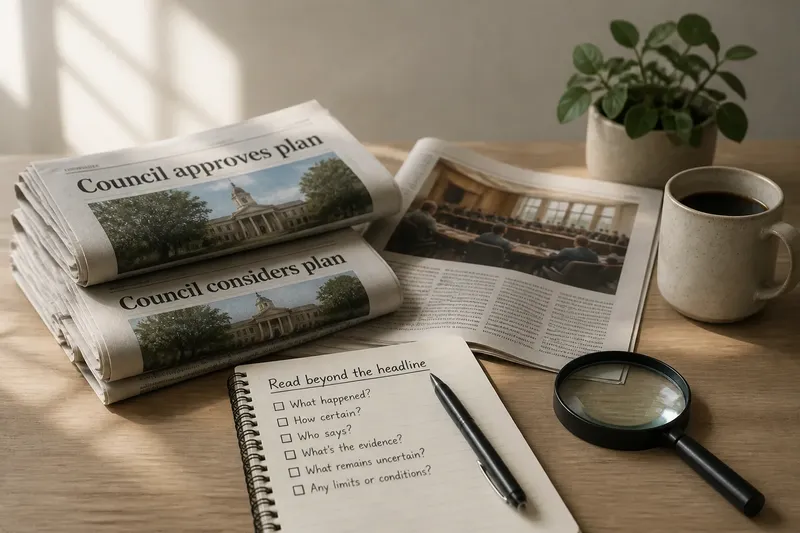
You see “Council approves plan” beside a story link, then “Council considers plan” in a second outlet’s version of the same news. That shift in verbs changes what you expect to learn before you reach the first paragraph. A headline’s promise is not the whole report: it is a compact claim whose force depends on its wording and the evidence the story supplies.
To read a headline carefully, first notice what it says happened, how certain it sounds and whose account it presents. Then compare that framing with the report’s details. The right approach depends on your situation: a quick scan calls for a different level of scrutiny from sharing a consequential claim or checking whether a story supports a strong accusation.
What does a headline promise?
A headline usually makes a claim about an event, a person’s action or the significance of new information. Its verb carries much of that claim. “Plans,” “weighs,” “approves” and “begins” describe different stages; replacing one with another can make a developing possibility sound settled.
Headlines also promise a particular kind of report. “Why the project stalled” implies an explanation, while “The project is stalled” asserts a state of affairs. A question such as “Could the project be delayed?” signals uncertainty, but it can still invite readers to focus on a possibility the story may later treat as remote.
Think of a headline as a luggage tag, not the suitcase: it points you towards what is inside, but cannot show every item. A useful reader checks whether the story’s contents match the label, especially when the wording makes a strong claim.
Which reading approach fits your situation?
If you are scanning a stream, what should you check?
Notice the main verb and the subject before deciding that you understand the event. Ask whether the wording describes a completed action, a proposal, a prediction or an allegation. If the difference matters to you, open the report rather than relying on the headline alone.
If you are about to share a claim, what should you verify?
Read enough of the report to identify who says the claim is true and what evidence is offered. Check whether the headline’s certainty matches the article’s account, and keep the subject and qualification intact when you describe it to someone else.
If the headline names wrongdoing, how should you read it?
Separate an allegation from a finding. “The company is accused of hiding losses” reports a claim made against the company; “The company hid losses” presents the conduct as established. Look for the source of the allegation, any response and the report’s account of what is known.
If the story is still developing, what wording matters?
Words such as “may,” “plans” and “is expected to” indicate that an outcome is not yet settled. Read the article for the stated basis of the forecast and for conditions that could change it, rather than treating the headline as a report of something already done.
How do verbs change the level of certainty?
Some verbs present an action as completed: “signed,” “voted” or “opened.” Others describe intention or possibility: “plans,” “could” or “is considering.” A headline can also report speech or a claim, using verbs such as “says,” “alleges” or “denies.” These are not interchangeable decorations; each tells you something about the status of the information.
Pay attention to the difference between an event and an interpretation of it. “The minister resigned” states an event. “The minister faced pressure to resign” describes a circumstance, not the outcome. “Pressure forced the minister out” adds a causal explanation that the report needs to support.
Certainty can be implied without an obvious word like “definitely.” A categorical verb, a named subject and no qualification can make a claim sound settled. Conversely, a question mark does not automatically make a headline cautious: the question may suggest an answer without establishing it.
How can you compare the framing with the report?
On opening the story, locate the first account of the event and identify whether it is attributed to a document, an official, a witness, a company or the reporter’s own description. Then check what the article says happened, what remains disputed and what evidence supports the claim. The headline may compress these distinctions, but the report should make them legible.
Compare the headline’s verb with the article’s timeline. If the title says a board “approved” a proposal, does the story describe a final vote, or only a recommendation awaiting another decision? If it says a policy “will change,” does the report identify a confirmed decision or a proposed course of action?
Also check whether the headline preserves the limits in the story. A report may describe a finding that applies to one location, a statement that has not been independently confirmed, or a forecast based on a stated assumption. If the headline drops that boundary, do not carry the broader version away as established fact.
What should you do when a headline feels stronger than the story?
Pause over the particular word that creates the stronger impression. Replace it mentally with a neutral description and see whether the article supports the original force. For example, “reveals” often suggests that concealed information has been uncovered; a report that merely repeats a public statement may not justify that implication.
Imagine you read “Harbour plan approved” while the article says a planning committee recommended the proposal and a separate council vote is still pending. The useful correction is not to guess what the council will do, but to describe the current state as a recommendation awaiting a decision. That wording preserves what the report establishes without borrowing certainty from the headline.
If a headline appears to misstate the report, check whether the story has an editor’s note or correction. A corrected headline may reflect new information or a clarified claim; the article’s note should help explain the change. Do not assume that every difference between two outlets is an error: they may be emphasising different parts of the same report.
Which words deserve a closer look?
Give extra attention to wording that turns a possibility into an outcome, a sequence into a cause, or a claim into a fact. These distinctions are easy to miss when a headline is short and familiar language makes a strong assertion feel routine.
- “Will” and “set to”: Check whether the report describes a confirmed decision or a forecast.
- “Admits”: Look for what the person acknowledged; the verb can suggest wrongdoing beyond the words reported.
- “Proves”: Check whether the article supports a firm conclusion or reports evidence that bears on a question.
- “Causes”: Look for evidence of a causal link, not merely two events occurring together.
- “Slams” or “blasts”: Read the quoted words to see whether the headline’s description of the tone fits.
These words are not automatically wrong. They make particular promises, and the report needs to meet them. Where the article uses careful qualifications, retain those qualifications in your own account.
How should you carry the story’s claim forward?
When you discuss the report, use the most precise wording the article supports. Attribute claims to their source, distinguish a proposal from an approved action, and say when an outcome is still uncertain. This is more useful than repeating a punchier headline that leaves the status unclear.
For a quick read, checking the main verb may be enough to decide whether to open the story. For a serious allegation, a public decision or a claim you plan to pass on, read the relevant passages and retain their limits. The central question in reading a headline is not whether it sounds confident, but whether the report earns that confidence.