The Trouble with Treating a Label as a Definition
News labels can orient readers, but they cannot explain a person or event. Learn how to read category words without mistaking them for the story.
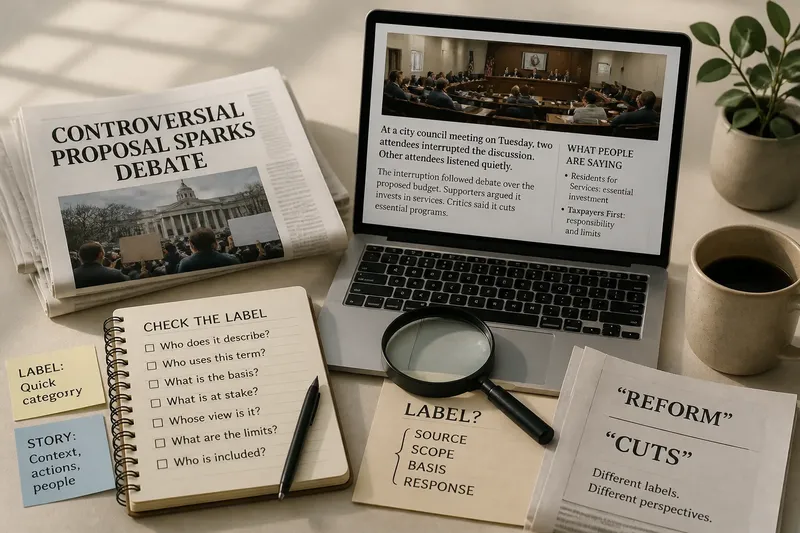
You open a news story and see a proposal called “controversial”. News labels can orient you before the first paragraph, but the word alone does not tell you who objects or why. To understand the story, look at what the label identifies and whether the account explains its limits.
A category can save space in a headline or caption, yet it can also make a judgement feel settled. The useful question is not whether labels should disappear, but whether the story gives you enough detail to understand the particular people, events or ideas being grouped together.
What does a label add to a story?
A label places a subject in a broad category. “Candidate” tells you that someone is seeking elected office; “protest” identifies a public expression of opposition. Those words help readers get their bearings, but they do not describe what a person proposes or what participants did.
Think of a label as a folder tab: it helps you locate the subject, but it is not the material inside. A report still needs to supply the relevant actions, roles and context rather than asking the category to stand in for them.
When does a label carry a judgement?
Some category words are openly evaluative. “Extremist”, “radical”, “illegal” and “violent” may refer to different kinds of claims, legal statuses or conduct. A story should make clear whether a word is the outlet’s description, a source’s characterisation or a formal classification—and explain what that distinction means in this case.
Other labels sound neutral but can still flatten differences. Calling a group “residents”, “workers” or “supporters” does not establish that its members share one view or act as a unit. Watch for wording that extends a claim about particular people to everyone in a wider category.
Contested terms also deserve context. One speaker may call a proposal “reform”, while an opponent calls it a “cut”. Naming both descriptions is not enough on its own: readers need to know which parts of the proposal each speaker is describing and what remains disputed.
How can you check whether a label fits?
Look around the word for the information that gives it meaning: who or what it describes, which features or actions prompted it, and whose description it is. If the label is a judgement, check whether the report distinguishes an allegation from an established finding or an attributed opinion.
For “controversial”, look for the disagreement: who objects, what they say is at stake and how supporters respond. If the account offers no such detail, the adjective may be doing the work of an explanation that the story has not provided.
- Check whether a label names the whole group or particular members; if the scope is broad but the account describes only a few people, read it as a claim about those people, or look for a more precise description.
- Check whether an evaluative term is attributed to a named source; if it is, treat it as that source’s view, or look for the outlet’s explanation before accepting it as the report’s own description.
- Check whether a formal category is explained; if the story names a legal or administrative status without saying what it covers, keep that status separate from wider claims about conduct.
- Check whether the report describes the action behind a word such as “violent”; if it does not identify what happened, do not assume the term applies to everyone present.
- Check whether a contested label has a stated basis and a relevant response; if either is missing, regard the description as incomplete rather than settled.
- Check whether the body of the story supports the headline’s category; if the detail is narrower, rely on the narrower account and note that the headline compresses it.
What should you check in a headline or caption?
Short formats often use categories to identify a story quickly. That can help, but a compressed label may sound more sweeping than the reporting beneath it. Compare the headline, caption or social summary with the article’s description of who acted and what happened.
Say an invented local report describes a council meeting where two attendees interrupted a discussion while others listened quietly. A short summary calls the gathering “an angry protest”. The article itself identifies the interruption, explains the disagreement and says the other attendees did not take part; that detail makes the summary’s broad label a poor fit for the whole gathering.
Pay attention to the subject of each sentence. A photograph may show a few people, while its caption labels a larger group; a short post may state an allegation without the qualification included in the full report. Ask who, exactly, the wording covers.
How can editors make a category more precise?
Editors can pair a broad label with the detail that makes it useful: a person’s role, an organisation’s stated purpose, the setting of an event or the action at issue. If evidence concerns only particular members, name that narrower scope rather than implying that it applies to everyone.
When a term comes from a source or authority, attribute it and explain the basis where relevant. That lets the reader distinguish the speaker’s wording from the story’s own description without pretending that attribution, by itself, settles the claim.
For example, instead of calling an entire gathering “violent”, an editor could describe the specific act under discussion and identify who is alleged to have carried it out. The more exact wording gives readers a clearer account of what the label was meant to convey.
What do readers often ask about news labels?
Should I disregard a label I disagree with?
Not automatically. Check whether the story defines the term, attributes it or supports it with details; then assess the account rather than reacting to the word alone.
Does attribution make a label accurate?
No. Attribution tells you who used the term, not whether it fits. Look for the stated basis, relevant context and any response included in the report.
What if the headline and article use different wording?
Compare the scope of each description with the details in the article. If the headline makes a broader claim than the reporting supports, treat it as shorthand that needs qualification, not as a replacement for the account.
Can a broad category still be useful?
Yes, when it gives readers a clear starting point and the story supplies the distinctions that matter. If those details are absent, keep your interpretation provisional rather than filling the gaps with assumptions.
How should you read a label that catches your eye?
Pause over the category and ask what it identifies, who applies it and what the story says about the people or events it covers. News labels can orient you, but the useful details are the ones that show how the description fits—or where its reach stops.
If the account leaves those details out, hold the label lightly. The practical task is to notice what it includes, what it leaves aside and whether the reporting gives you enough context to judge the distinction.